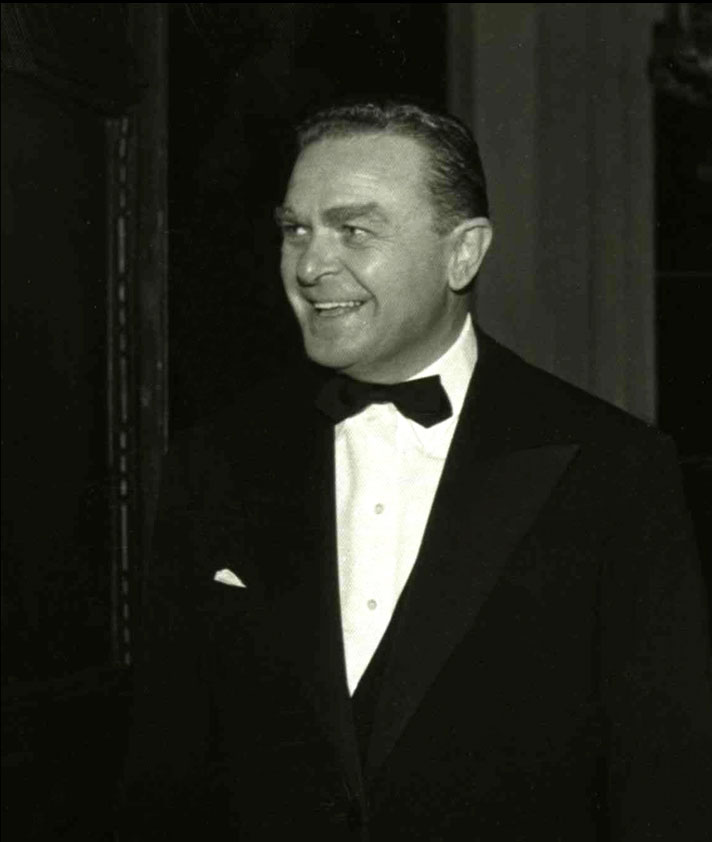
Stefano Rivetti di Val Cervo
Biographical notes
He was born in Turin on June 2, 1914, the first of four children of Silvia Negro and Count Oreste Rivetti di Val Cervo, one of the most illustrious names in the Italian wool industry. He graduated in economics and business, specialized in Germany in textile engineering, was a cavalry officer, and was raised in his father’s great school. He took his first steps in industrial activity by gaining practical experience in the various departments of his father’s factories in Biella.
In May 1943, he married Francesca Barbò di Casalmorano Barbiano di Belgioioso d’Este, with whom he had six children: Silvia, Pia, Oreste, Chiara, Albertina, and Guglielmo. He later rebuilt the family business group in Lucca, which had been destroyed by the war, and then managed it alongside the one in Florence, creating an important industry specializing in household linen and fabrics for international haute couture.
In 1953, at the invitation of the government and following the opportunities provided by the Cassa del Mezzogiorno, he created the largest wool complex in the South of Italy. The Maratea wool mill “R1,” and later those of Praia a Mare “R2,” “R3,” “R4,” “RX,” and the well-known company “Lini e Lane”, relocated from Florence, were built with cutting-edge criteria, making them among the most modern factories in the world at the time. Alongside his industrial activities, Stefano Rivetti established a livestock company for milk and egg production, an agricultural and floricultural company called “Pamafi,” which included a grand complex of very modern greenhouses.
A lover of nature and beauty, Stefano Rivetti recognized the great potential of Maratea in the tourism sector, and invested energy and resources to enhance and promote the magnificent coastline and splendid territory. He built the most luxurious hotel in Basilicata, the “Santavenere Hotel,” the elegant nightclub “Le Ginestre,” a beach resort, villas with squares, bars, and shops, public recreational areas, even a church with a residence for the priest and a garden with a playground for children.
He was the initiator of the creation of the Azienda Autonoma di Soggiorno e Turismo, the first of its kind in Southern Italy, where he served for several years as president, financier, and organizer. He also took charge of and was president of the city hospital, promoted local craftsmanship, encouraged the construction of roads and the port of Maratea, and created many initiatives for the development of the Gulf of Policastro and surrounding areas. Until the last days of his life, with his thoughts on his beloved territory, he continued to study new projects, including that of a canal port in the plain of Castrocucco di Maratea.
He passed away in Vence (France) on October 7, 1988.